International collaboration
Documentation updated: 15 September 2026.
The KBFI HPC cluster connects Estonia to the international computing infrastructure of the Compact Muon Solenoid (CMS) experiment at CERN. KBFI operates Estonia's Tier-2 site in the Worldwide LHC Computing Grid (WLCG), the global system used to store, distribute and process data from the Large Hadron Collider (LHC).
CMS and the Worldwide LHC Computing Grid
CMS is one of the LHC's large general-purpose particle-physics experiments. The detector records far more data than a single computing centre could process and store. WLCG therefore links computing centres around the world into one distributed infrastructure serving CMS and the other LHC experiments.
In the tiered computing model:
- Tier-0 at CERN performs the first processing of data recorded by the experiments.
- Tier-1 centres provide large-scale storage, data distribution and reprocessing.
- Tier-2 centres, including KBFI, provide computing and storage for simulation, data processing and scientific analysis.
Data and computing tasks move between centres according to the needs of the collaboration. This allows researchers in many countries to work with the same datasets and contribute computing capacity to a shared scientific programme.
KBFI's role
Within CMS and WLCG, the KBFI cluster:
- processes centrally managed CMS computing workloads;
- stores and distributes CMS datasets;
- provides resources for simulation and physics analysis;
- exchanges data with other WLCG centres over international research networks; and
- operates and monitors the services expected from a WLCG Tier-2 site.
The site appears under different identifiers in the collaboration's systems:
| Context | Identifier |
|---|---|
| CMS site | T2_EE_Estonia |
| WLCG/EGI resource centre | EE-NICPB |
By operating these services, KBFI contributes Estonia's computing capacity to CMS while giving Estonian researchers direct experience with an international, large-scale scientific infrastructure.
Contribution and service quality
The long-term records below show both the computing delivered by Estonia's Tier-2 site and the quality of the services it provides to CMS. They are dated historical summaries, rather than live status displays.
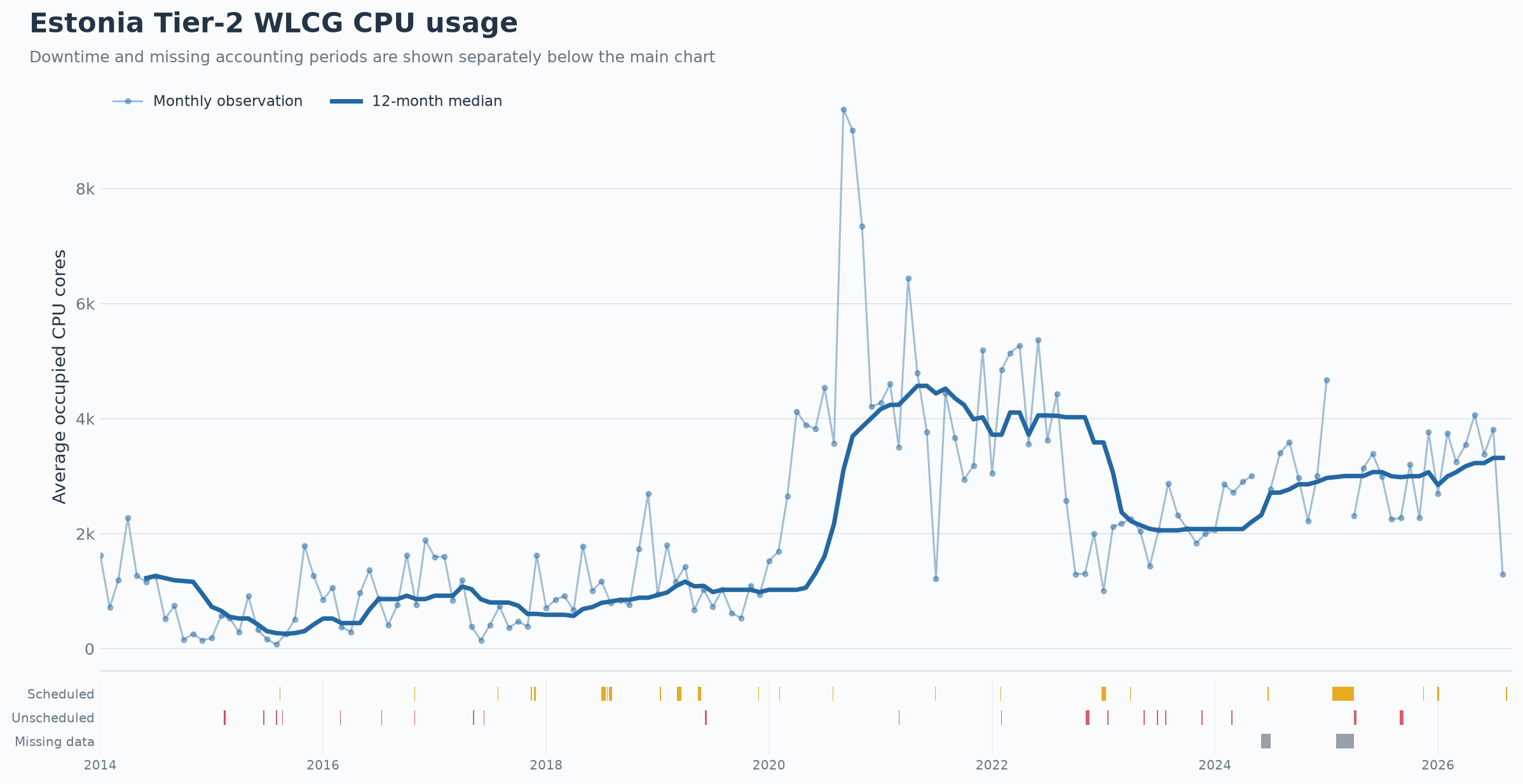
Monthly CPU use reported for T2_Estonia, with a rolling 12-month median.
The record is current through August 2026. Declared downtime and gaps in the
source data are shown separately below the chart. Source: EGI Accounting
Portal.
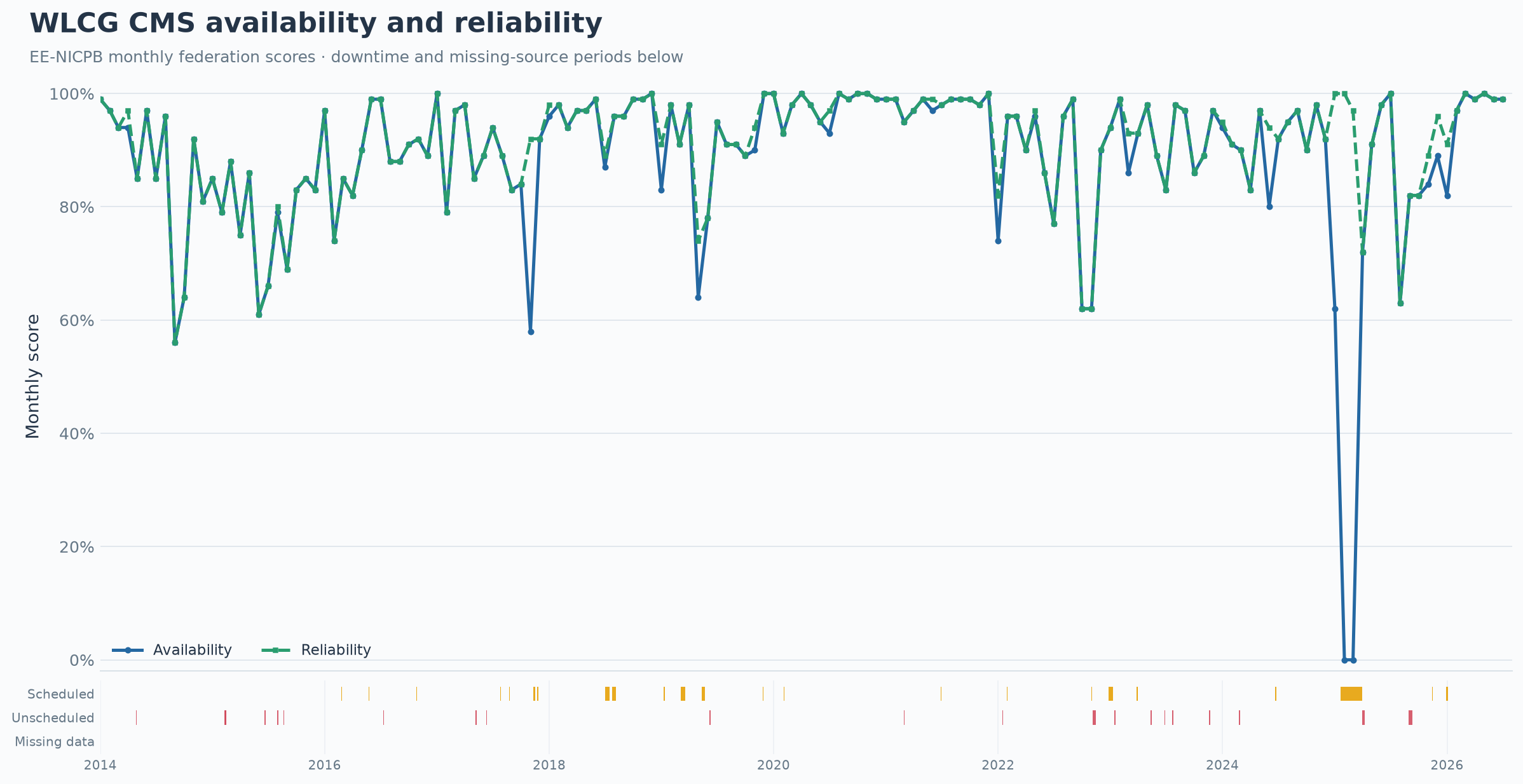
Monthly CMS service-quality results for the EE-NICPB federation. The record
is current through July 2026, the latest complete WLCG report available when
this page was updated. Source: WLCG reliability and availability reports.
In WLCG reporting, availability is the share of known monitoring time for which the required services passed their tests. Reliability measures the same service status after declared scheduled downtime is excluded. Reliability can therefore remain high during planned maintenance, while availability may fall. Periods with unknown monitoring status are excluded from both measures and are shown separately in the chart.
See the WLCG reliability and availability reporting page, the WLCG calculation definition, and the monthly WLCG reports for the source material and methodology.
External resources
- CMS experiment — the experiment and its research
- CMS Collaboration — participating institutes and the international collaboration
- CMS computing grid — an introduction to how CMS data moves through the tiered computing system
- Worldwide LHC Computing Grid — WLCG's role, organization and participating infrastructure
- WLCG collaboration agreement and centre lists — formal collaboration documents and current Tier-centre annexes
- EGI Accounting Portal — public accounting data for distributed computing resources
For instructions intended specifically for CMS users, see CMS dataset management.